Having lived most of my life in New York City, I am conditioned to act in particular ways - a characteristic which I share with all people who live in large metropolis. There are just so many of us in a city, crowded together, on top of one another, in such small spaces. Those unaccustomed to this kind of living must wonder how it is possible to maintain sanity and composure. It is possible because every person is encapsulated by anonymity. Moreover, an unacknowledged agreement exists between every person that that anonymity must not be compromised. That cloak of anonymity, in fact, provides physical space by effacing the existence of others. To acknowledge the other is to deprive ourselves of physical space.
Years of living amongst friendly Midwesterners, I'm afraid had absolutely no effect. But of course, I had no reason to change my habits since I was just passing through. Guadeloupe is different because I intend to stay, at least for a while. M. and I live in a quiet little neighborhood far from the larger cities of Pointe-à-Pitre and Basse Terre; there is simply no physical pressure to provoke the need for anonymity. And of course, there is island culture, which almost demands a certain degree of familiarity and friendliness amongst strangers.
Still, habits die hard. The confrontation of my city attitudes and expected behavior is best illustrated when I pass a stranger on the street. It is absolutely normal - and indeed expected - to greet anybody that one comes across with a simple 'bonjour' or 'bonsoir'. But lacking the habit of doing just that, I find myself in a slight panic whenever I cross somebody else's path. When should I greet them? When our eyes first meet? When we're within arms length of each other? And what happens when we're on opposite sides of the road? Are women expected to initiate, as they do for handshakes?
Even the most insignificant social interaction is a intricate combination of expected attitudes and behaviors. I am completely awkward when it comes to hello. I underestimate the distance my voice will carry and often my greeting dissapates in the air before the person has heard. I hesitate, and there are moments of tense eye contact. I stumble and begin again, greeting them twice. Sometimes my silence is misjudged and the stranger's hello comes too late for me to respond in kind. So lost was I that in the beginning, I ignored adorable grannies and had warm hellos for louche individuals. I am getting better at it; most of my hellos pass now with studied ease. Though I wonder how long it will take before these hellos become an ordinary reaction, and not the result of intense analysis and speculation.
Tuesday, April 7, 2009


Saturday, April 4, 2009
Green Sauce
 I had always considered parsley to be simply the decorative bit of green found on the meat-heavy plates of American cuisine. I did not think of it as a herb, at least not in the way I thought of sage in roast chicken, or cilantro in a Chinese stir-fry. And in any case, I found its taste soap-like.
But tastes change and mature. Otherwise, I would still think ketchup the ultimate condiment, and a great accompaniment to a bowl of white rice. M.'s mother uses parsley occasionally in her cooking, and the taste has grown on me. I found I rather liked the taste of parsley in an omlette, for example.
I do believe, however, that I am about to embark upon a love affair with parsley. Recently, I ate at the restaurant La Paillote du Pecheur, where I had an incredibly tasty parsley and green onion sauce. It was set on the table in a small bowl. I assumed it was for the salad and spooned some onto my tomatoes and lettuce. It seemed like it might have also been placed there for our fish, and so spooned some onto my grilled mahi-mahi steak. It worked equally well for both. Indeed, I liked it so much that I decided to try and make it at home. It seemed easy enough. La Paillote is a typical fisherman's restaurant in Guadeloupe where the food is simple but fresh and carefully prepared. There couldn't have possibly been any surprise ingredients.
I made a small bowl and kept it in the fridge. I used it first as a salad dressing. Over the coarse of the week, I found other opportunities: as a dressing for some boiled pasta, then topped with Romano cheese; a spoonful in a creamy baked pasta for some extra flavor; the remainder used to sauté green beans. I was really pleased by its versatility, and its ability to add some extra flavor. Instead of adding a tablespoon of olive oil, I would add two tablespoons of the sauce.
There is nothing particularly Caribbean about the sauce, but since I had it first at a local restaurant, I thought it could still make the recipe list.
Ingredients:
onion
green onion
parsley (flat or curly leaf)
olive oil
salt
1. Finely mince onion, green onion, and parsley.
2. In a small bowl, combine onion, green onion and parsley.
3. Add enough olive oil to submerge mixture.
4. Add salt.
I'm fairly certain you could keep the sauce in the fridge for at least two weeks, but we've always finished each batch within the week, so I cannot say. There aren't any quantities, because its really a matter of taste. I make it with about equal parts onion, green onion, and parsley. M. likes onions a bit less than I do, otherwise I might increase the quantity of onions. I've been using regular yellow onions because that is what is available here, but I think red onions would work really well.
 *ADDENDUM* (April 7, 2009) Works really well in chicken salad too. One part green sauce to one part mustard to two parts mayonnaise.
Thursday, April 2, 2009
La Case à Fernand
 La Case à Fernand is located in Anse Bertrand in Grand Terre. Here, one gets the impression that décor isn’t just paid lip service. The restaurant is painted in pretty pastels, and decorated with watercolors of local scenes.
The view from the terrace is spectacular: the turquoise waters of the Caribbean playfully wash up against the main road. To come for just a drink and the view would be quite sufficient, but happily, the food is also very good.
The cuisine is not entirely traditional créole - not surprising since the restaurateur is a métro from southwestern France. I had grilled thazard (a type of mackerel), served with white rice, lentils and mashed yams, whereas M.'s brother had a plate of ceviche, thinly sliced.
 Above: My bento box of grilled thazard.


La Porte d'Enfer
 The imposing cliffs of the north eastern coast of Grand Terre have been carved by the unrelenting wind and waves of the Atlantic Ocean. The limestone admirably withstands the crashing waves save one particular spot: Hell's Gate.
 Above, the mouth of La Porte d’Enfer.
Here, the Atlantic has managed to find a weak spot, carving out a wide-mouthed fjord. The waves crash into the fjord, pushing the water into the interior, tumbling over rocks and licking the shores of both sides. The water calms by the time it reaches the very end of the fjord, the Atlantic having lost its force to become gentle ripples that caress the white sand beach.
 Above, the ocean water cuts a winding path through solid rock, ending at a small protected beach.
 La Porte d'Enfer pleased me immeasurably. I felt as if I were witnessing the timeless battle between water and rock. Only here, the battle takes on enormous proportions, two titans fighting to the death before my very eyes. The way in which the ferocity of the Atlantic is controlled and tamed by the limestone walls is impressive. The race of water is absolutely mesmerizing.
Left, along the shore, traces of the rock's former life as coral reef.
There were sheltered picnic tables at the beach, and a absolutely illegal (1) informal restaurant has been set up along side the road. I would have loved to stay, to see La Porte through the different hours of the day. But we had come unprepared, and so we drove to Anse Bertrand and ate at La Case à Fernand.
(1) See Loi Littoral in this post.
Wednesday, April 1, 2009
Door to Door
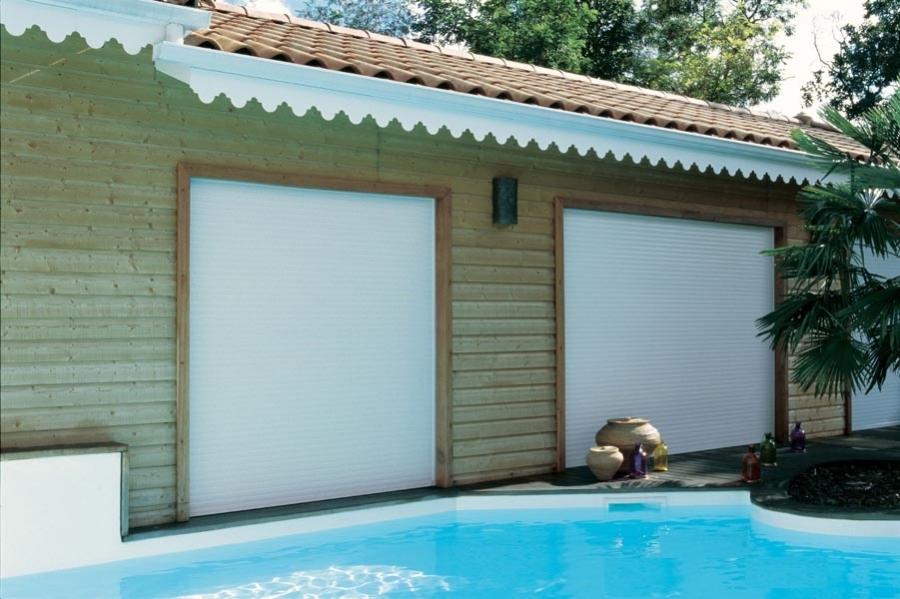
Yesterday, in the afternoon, a man in a blue car drove up to the house, honked his horn, and got out. Thinking it was for our neighbor, I paid him no mind; we rarely have unannounced visitors. But he climbed down the stairs to our terrace and met me at the door. He was heavy-set white man with the look of a laborer. A slurry of words came out of his mouth. I caught just enough to understand he was selling stores - those descending aluminum shutters that we might find on a store front in the US but are used on houses here and in France métropole. He asked without reserve whether or not we were owners or renters, but his eyes wandered already having guessed the answer. He got back into his car, and I heard him barking his same introduction at the neighbor's up the road.
He had unnerved me somewhat. I thought traveling salesmen were supposed to be clean-cut, slick. This man was rather too grimy to be slick. And he had breached the steps of our terrace without having asked permission. Even the police aux frontières, whose job it is to be intrusive, stopped at the steps! But, I did not think much more of it.
Until today. When in the morning, a white delivery van drove up to the house, and honked his horn. This time, I did wait to see who it was for. I went out to him. He remained in his van and politely explained that he was in the neighborhood making a delivery. Thinking he was in need of directions, I began laying out a map in my head and prepared to give him what clumsy direction I could. But no, he was not lost. He was, in fact, delivering a mattress, and he had additional ones in his van which he was offering for sale at 50% off and was I interested. I said no, and he drove off to the neighbor’s up the road.
How strange! There have been no salesmen except for the Jehovah's Witnesses selling their God. How strange it is to have one immediately after the other. One selling stores, one selling mattresses. Not your usual door-to-door fare. I can only think that the month-long strike has delivered a horrible blow to certain businesses, not simply those related to tourism, and their owners are desperate to bring in income.
I do regret that M. was not at home when the mattress man came by. The two mattresses in the house are not very comfortable. We might have gotten a good deal on a much better mattress.
I am wondering who might show up tomorrow selling his wares. I am in need of a blender.
Tuesday, March 31, 2009
Plage de Roseau
While M.'s parents were visiting, I had a chance to visit the beach of Roseau, which is just outside Sainte-Mairie. Roseau is composed of a series of tiny bays, separated by breakwaters of black volcanic rock.
 Beige sand covers the beach. Though, there is not so much beach as a narrow band of sand that quickly turns to dirt. The rather wide expanse of dirt is dotted with sea grapes and coconut trees.
 The rocky arms of the breakwaters protect the tiny bays from waves. The water level rises very gradually...until it reaches a sandbar.
(Left: Each bay is a perfect pool. A swimmer is heading outwards while another is standing on the sandbar.)
 The beach is less than 5 mins away by car from Sainte-Marie. It would be very easy to eat at a restaurant or to buy something at a bakery en bourg. On the beach itself, vendors set up tables to sell drinks (rum punch included), snacks and of course, coconut sorbets. There are a number of sheltered picnic tables towards the northern end of the beach.
(Left: A tourist buys himself a snack from a vendor.)
I'm afraid the pictures here do not do Roseau justice; I took these pictures as an overcast sky edged towards afternoon. Roseau is a bit rough - in the way the green overgrowth seems to push at the border of the beach itself, and in the way people sit in their cars, with their feet and arms dangling out, several feet from the lapping water. The mixed cocktails and white sand are elsewhere. Come here to escape the feeling that Guadeloupe remains a colony of France.

 Plage de Roseau
A series of tiny bays, each lined with a narrow strip of beige sand (leading quickly to dirt). The water remains shallow quite far out and there are practically no waves, making it a very good choice for children and weak swimmers. However, do not attempt to swim from one bay to the next as there is a strong current. This is the closest beach to the heavily populated Capesterre-Belle-Eau; it is extremely popular with locals. Both the ambiance and crowds (especially on Sunday) reflect that. Come during the week for a bit of quiet; come on Sunday to feel like a local.
Location: Just outside of Sainte Marie, not far from Capesterre-Belle-Eau (Basse Terre)
Parking: Parking is officially limited to the road leading up to the beach, but this is usually ignored. Many people simply park their cars where the beach ends and the dirt begins. Apparently, there is a pay parking lot at the entrance to the beach, but we have never seen this in operation.
Food: There are various vendors who set up tables selling coconut tarts, rum punch, candy, etc.
Public Showers: Yes. Though, you barely want to walk within 5m of the building...
Public Restrooms: ...let alone use the toilets.
Tuesday, March 24, 2009
That Elusive License
 (Above, the goal: a French driver's license)
Somehow, I managed to make it to my mid twenties without learning how to drive. Not particularly hard for a native New Yorker, but surprising still since I've lived in various elsewheres.
It never seemed odd that I didn't have a driver's license. Growing up, most of the people I knew didn't have one. I didn't realize how odd it was until I went to a large Midwestern university for undergraduate studies. Somehow, it would come up in conversation and people would be in disbelief. There isn't a need for it, I would explain. And that made sense to them. Quickly, not knowing how to drive became a characteristic I proudly assumed.
Still, I began to have the idea that having a license might be useful. I eventually got myself a driver's permit. Sadly, though, I lacked the follow-through to get my license: I allowed the permit to expire (yes, they do expire). Subconsciously, perhaps, I was reluctant to prepare myself for a life outside of New York.
But I left again anyway, this time for graduate studies. Not having a license or a car was crippling. Somewhat quaintly, I had thought learning to bike might be sufficient, mistaking the Midwest to be similar to the under-served areas of the outer boroughs. The reality sunk in the first time I biked home, laden with grocery bags, uphill. And yet, I returned to New York after two years, still without a license.
I have finally met my match. Life in Guadeloupe is simply not possible without a car (and by extension a license). Of course, there are buses, but they are dreadfully inconvenient. It was only this past year that formal stops were made. Previously, buses stopped any where - convenient for anybody getting on or off, but made for a very long ride for everybody else.
I signed up for driving lessons today. I don't know why I didn't begin sooner. I suppose its more of that same reluctance that has kept me license-less all these years. I am nervous about the whole thing. Though I think most people would be nervous about driving in Guadeloupe. The narrow roads are shared by cars and lorry trucks alike; people often walk along the roadside. The roads twist and turn, sometimes in hairpin curves. And most worrisome, Guadeloupeans prove that they are every bit French especially when behind the wheel.
I'll have to pass the written exam (le code) before I start actual driving lessons. I'll be studying all day tomorrow since I have my first session for le code on Thursday.
Subscribe to:
Posts (Atom)